In Search of Perfection: Ansel Adams and Max Dupain at Bayside Gallery, Brighton
Exhibition review
Max Dupain and Ansel Adams: In Search of Perfection Bayside Gallery, Brighton, Victoria. 20 June – 30 August 2026. Free entry.
There is a photograph on the wall at Bayside Gallery that stops you mid-step.
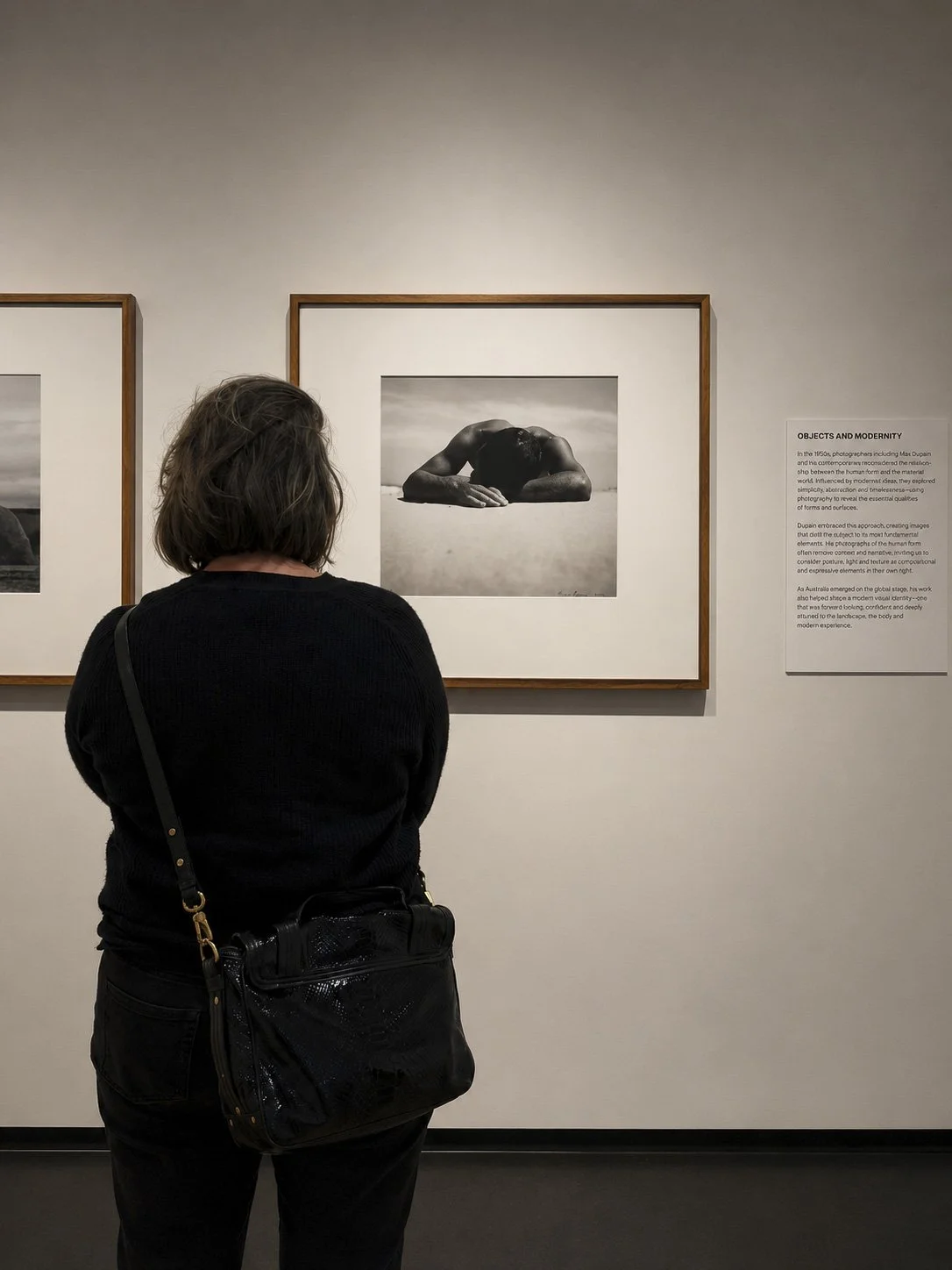
Sunbaker. A man face-down on a beach, arms folded beneath his head, the Australian sun flattening everything into geometry — muscle, sand, shadow, light. Max Dupain made it in 1938. It has been reproduced so many times that you think you know it. You don't. Not until you stand in front of a print and feel the scale of it, the grain of it, the weight of a summer afternoon held perfectly still inside a rectangle of silver gelatin.
Then you understand why this image has become something close to a national unconscious — not simply a photograph of a man on a beach, but a portrait of an entire country learning what it wanted to be.
Across the room, Ansel Adams' Moon and Half Dome, Yosemite National Park, California, 1963, does something different and equally devastating. The granite face of Half Dome fills the frame like a cathedral wall, lit on one side, in deep shadow on the other, and above it — barely, quietly — a moon. It should not work as well as it does. The elements are almost too grand, too deliberate. And yet the print silences you.
Whatever Adams was feeling in that moment in Yosemite has survived the decades intact, travelling through silver and paper to arrive, undimmed, on a gallery wall in Brighton.
Two photographers. Two continents. Two rooms. And between them, one of the most quietly remarkable exhibitions Melbourne has seen this year.
Max Dupain and Ansel Adams: In Search of Perfection is a National Gallery of Australia touring exhibition, curated by Anne O'Hehir and presented with the support of the Bowness Family Foundation. Bayside Gallery is the only Victorian venue on the national tour — a fact worth pausing on. This is a rare and generous thing to have on your doorstep, and free.
Exhibition overview
Two photographers, two continents and two distinct ideas of perfection — brought into conversation through the physical authority of the black-and-white print.
01 · Two photographers
A conversation across continents
The exhibition brings together 63 works, placing Dupain's architectural photographs and intimate studies of Australian life alongside Adams' monumental landscapes of the American West. It is, remarkably, the first time the two bodies of work have been shown in conversation. That it took this long is the exhibition's quiet provocation. Once you see them together, the correspondence feels almost inevitable.
Both men were born within a decade of each other — Adams in 1902, Dupain in 1911. Both worked almost exclusively in black and white, not from limitation but from conviction. Both understood that tonal precision was not a technical achievement but a moral one: a commitment to seeing clearly, to rendering the world with honesty and control rather than sentiment. Both became, in their respective countries, something photography rarely produces — household names.
Icons of a medium that usually keeps its practitioners obscure.
Exhibition view · A dialogue in black and white
02 · Curatorial architecture
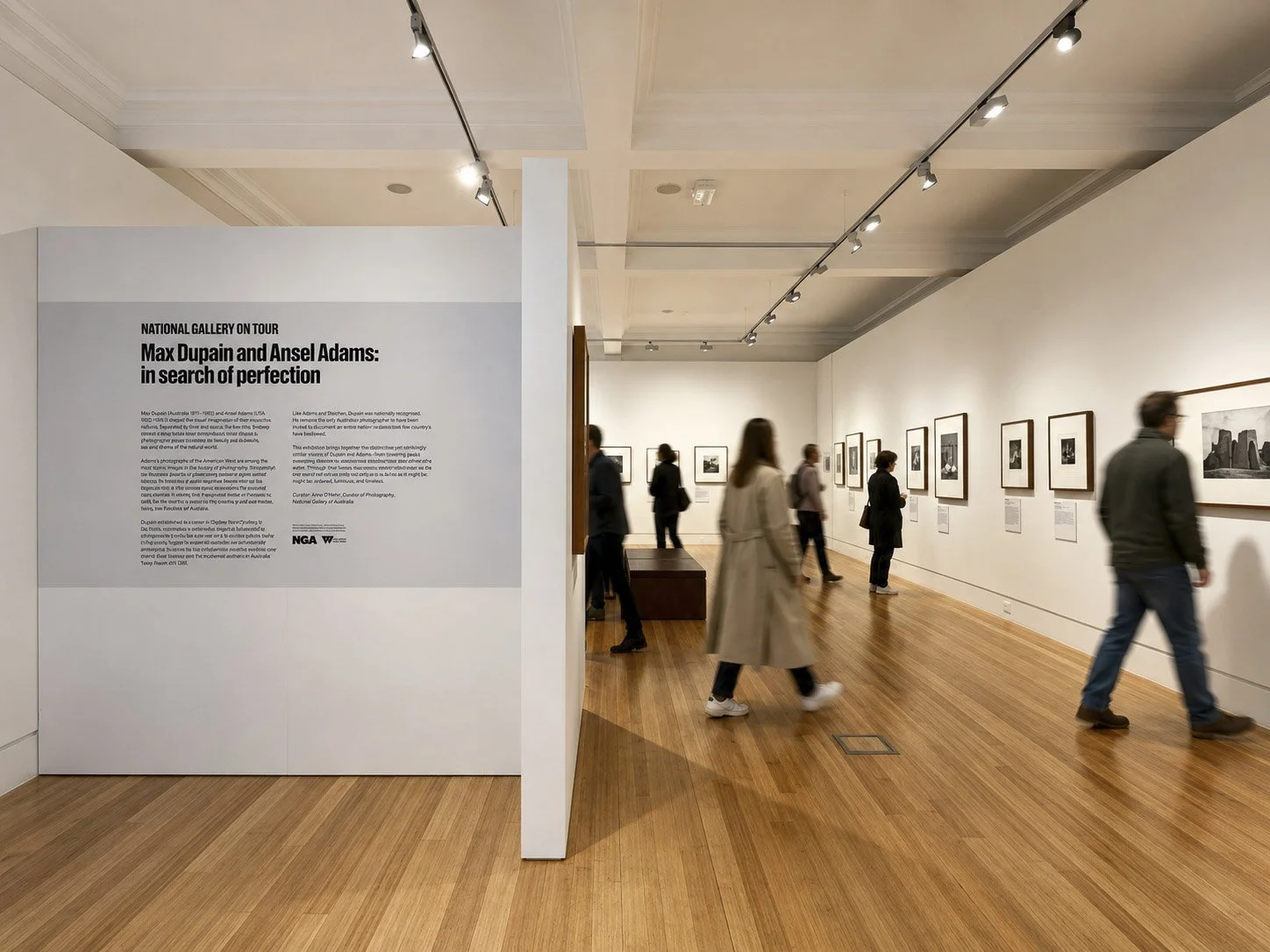
Two rooms, two atmospheres
The two rooms tell different stories, and the distinction is intentional.
The first room — high ceilings, timber floors, white walls — holds works that breathe. Dupain's Sunbaker hangs here, and his City Lights of 1937: the Sydney Harbour Bridge photographed at night from above, traffic streaking into diagonal lines of light, the structure becoming pure abstraction. Beside it, Modern Chord, 1934 — the cables of the same bridge reduced to a handful of parallel lines converging in darkness, a small print that somehow fills the room.
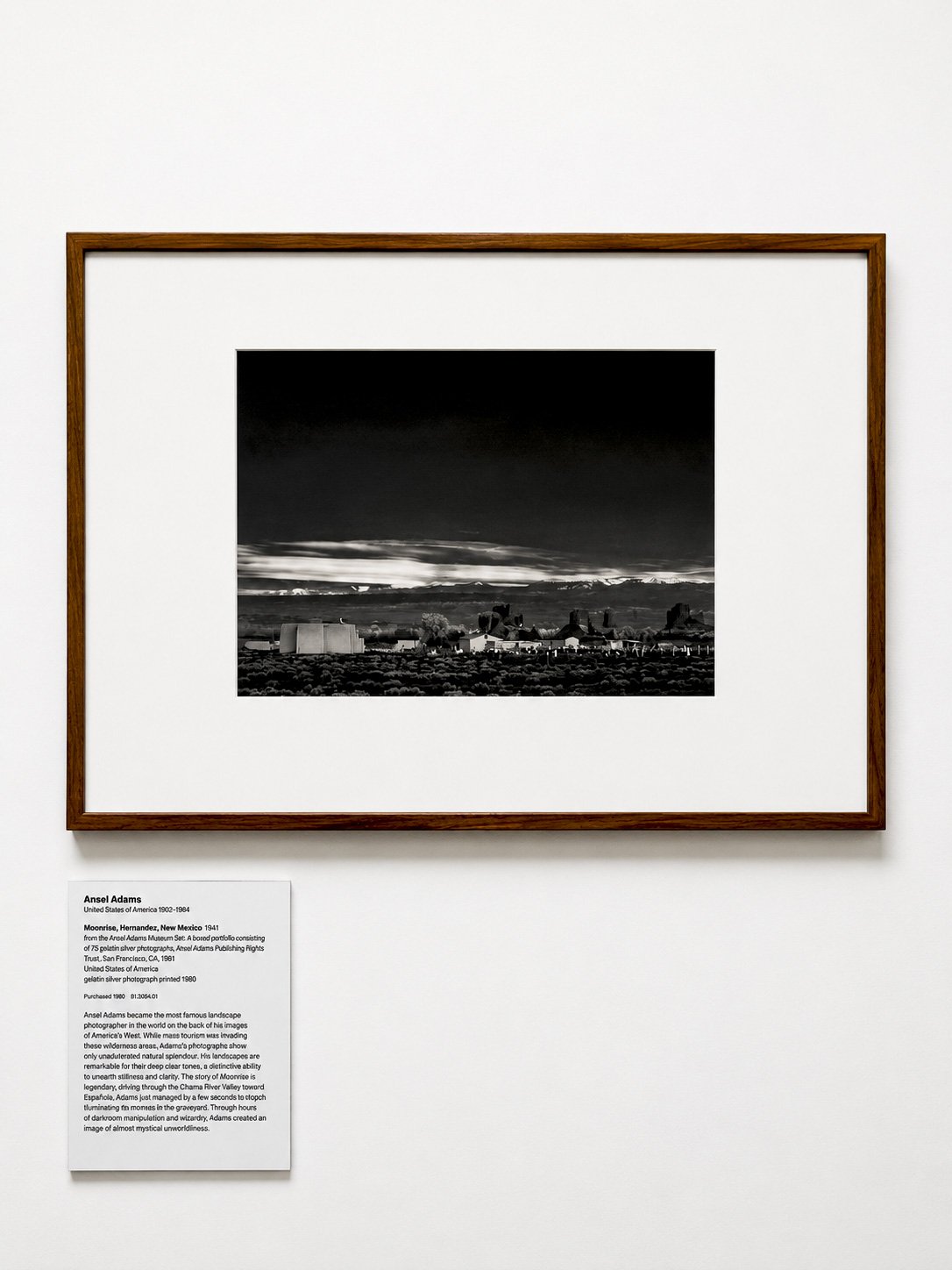
These are images made in the flush of a young country discovering itself, and they carry that energy still. Adams' Moonrise, Hernandez, New Mexico, 1941, hangs here too — wide, horizontal, the village small against the vast dark sky — and it is the print that rewards the longest looking. The longer you stay with it, the more the sky deepens. Adams darkened it almost to black in the darkroom over years of printing, and the result is an image that feels less like a landscape than like a threshold.
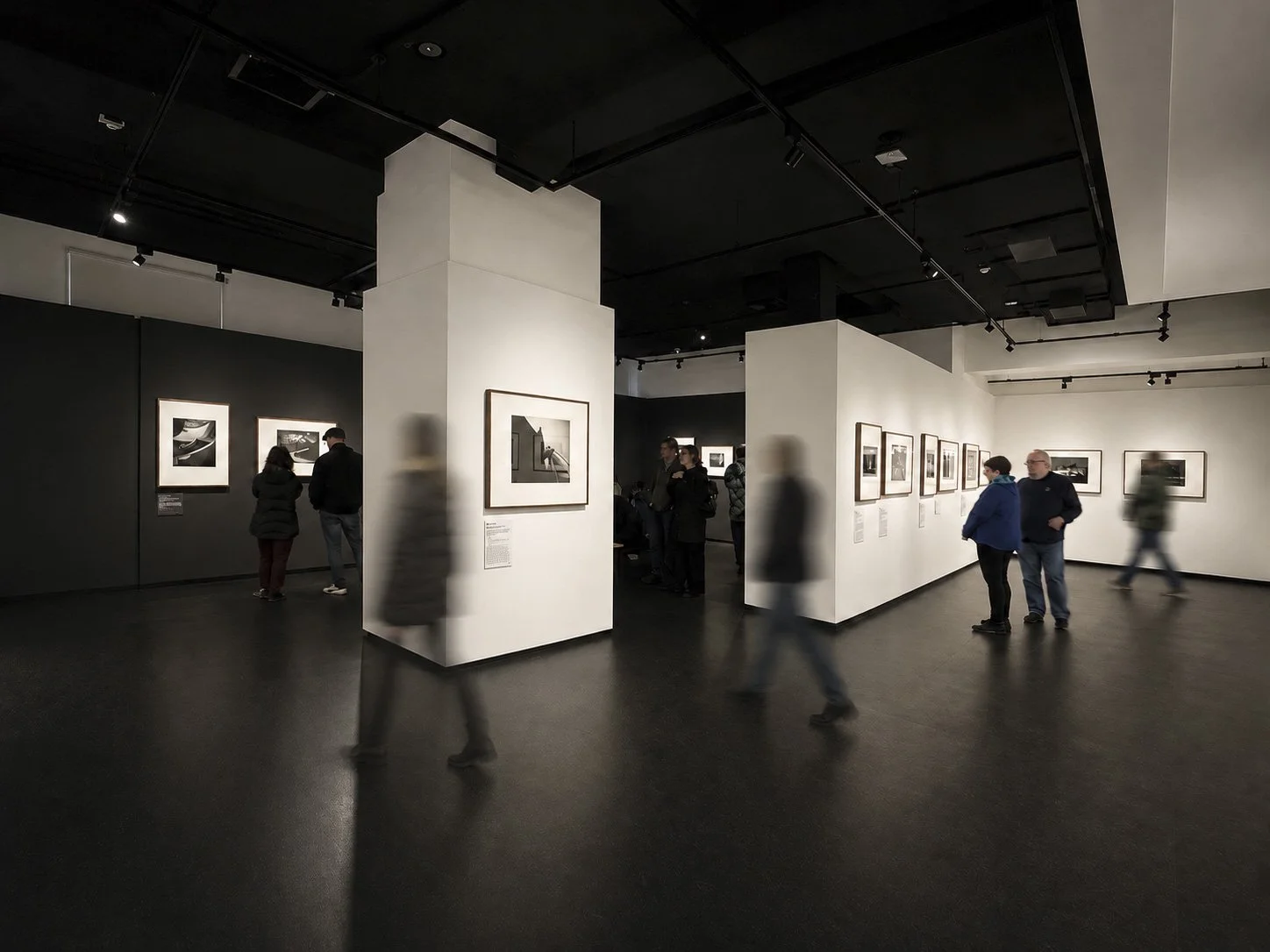
The second room is something else. A black ceiling, a dark floor, walls split between white and near-black. The shift is immediate and physical. Adams' Canyon de Chelly, Arizona, 1942 — geology rendered as pure drama, the canyon walls lit and shadowed in a way that makes geology feel alive — hangs on black, and it lands with a force that the same print on white would not carry. Winter Sunrise, Sierra Nevada, 1944, burns white against the dark wall.
Half Dome, Merced River, Winter, c.1935, printed later, reflects perfectly in still water below a snow-laden Yosemite that feels almost unbearably beautiful.
Dupain's architectural work dominates the black walls of the second room, and this is where his range becomes undeniable. The Spiral Stair, Lidcombe College, 1980 — raw concrete, a half-moon of void, a central column rising into grey light — is architectural photography that has crossed into something else entirely.
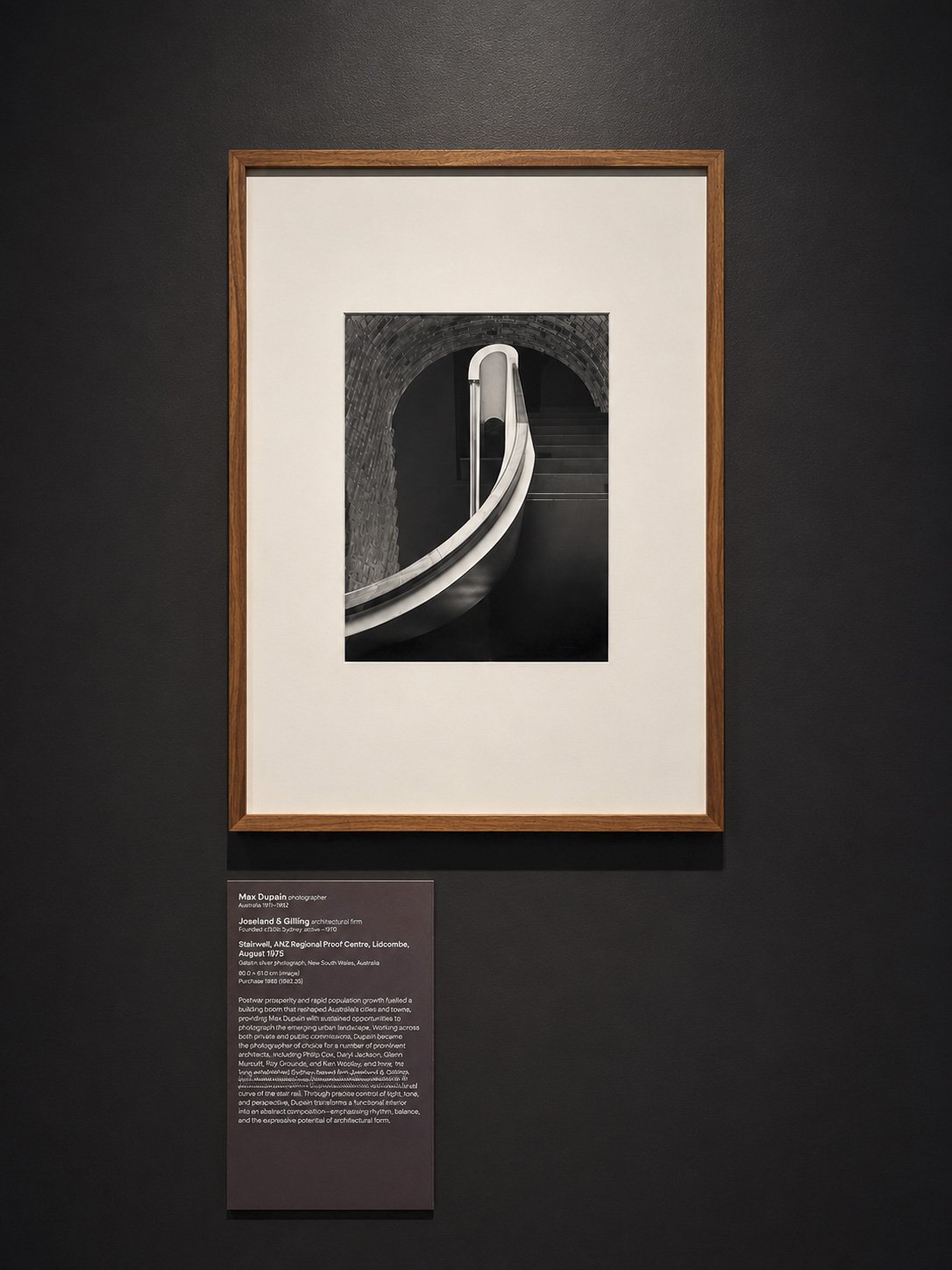
The Stairwell, ANZ Regional Proof Centre, Lidcombe, 1975 — a brick arch framing a gleaming handrail curving into darkness — is compositionally perfect in the way that only images made by someone who genuinely loves structure can be. And the Australian Square Tower, October 1968 — Seidler's tower photographed from below, a tiny human figure ascending the stairs at its base, the building disappearing into sky — makes the human body feel both diminished and heroic at once.
The wall colour is not decoration. It is curation. The black walls amplify drama and structure. The white walls allow intimacy and air. O'Hehir has used the gallery's architecture as a curatorial instrument, and the result is an exhibition that feels considered at every turn.
The second room · Darkness as a curatorial instrument
03 · Presence and scale
Adams and the infinite
Adams arrives carrying the full weight of his reputation — and the prints bear it without strain.
Moonrise, Hernandez, New Mexico, made in a single exposed frame on a New Mexico roadside in 1941, dying light already fading, no time to meter, no second chance — is one of the most consequential images in the history of photography. The small adobe village, the white crosses of a cemetery glowing against darkening fields, a full moon rising into a sky Adams would burn almost to black in the darkroom.
To see that print in person, after years of encountering it only in reproduction, is to understand something no book can carry. The scale of the sky. The silence in it. The sense that this is not a document of a moment but a reckoning with the infinite.
That print feels particularly charged right now. Just weeks before this exhibition opened, a New York gallery was selling an AI-generated colourised version of Moonrise — prompting a public statement of condemnation from the Ansel Adams Publishing Rights Trust. The controversy landed precisely where it should: as a reminder that Adams' images carry an authority built on presence, patience, and physical commitment to a place. An algorithm can be prompted to reimagine Moonrise.
It cannot stand on a New Mexico roadside at dusk with a failing light and one frame left and make the decision Adams made. The difference is not technical. It is everything.
04 · Depth of feeling
Dupain is the revelation
Dupain is the revelation.
It is not Sunbaker alone — though that print is worth the visit by itself. It is the range. The architectural studies. The still lifes. The portraits. The bridge abstractions. And that Dupain quote, printed on the wall and felt in every frame: "I've always believed a great photographer should concentrate more on depth of feeling and less on depth of field." Where Adams builds toward the monumental, Dupain arrives somewhere more intimate, more attentive to the texture of daily life.
His images of Harry Seidler's modernist buildings carry the same formal rigour as Adams' granite faces, but they breathe differently. They feel inhabited. Stripped of everything unnecessary, they reward the kind of slow looking that most contemporary image culture no longer has patience for.
Two approaches · Monument and intimacy
05 · The considered print
Slowness, print and selective vision
There is a telling detail buried in the exhibition's research. Dupain's assistant Eric Sierins noted that Dupain felt Adams spent too much time planning the technical side of his photography — that the results could, as a consequence, feel cold. It is a generous disagreement between equals. Standing in the room with both bodies of work, you can feel exactly what Dupain meant, and exactly why Adams would have contested it.
Both men worked with a commitment to slowness that contemporary image culture has almost entirely abandoned. Adams' zone system — his method of pre-visualising the full tonal range of a print before the shutter was pressed — required a depth of preparation that sits at the opposite end of the spectrum from the instant, high-volume image-making that now defines most of what we call photography.
Dupain's devotion to the darkroom, to the considered print, to the relationship between negative and paper, speaks the same language.
What this exhibition argues, quietly and without declaring itself, is that the print is not a byproduct of photography. It is the point. The slowness is not a constraint. It is the practice.
The print is not a byproduct of photography. It is the point. The slowness is not a constraint. It is the practice.
The exhibition is not without its complications. Adams' landscapes carry a beauty that has always existed in tension with the history of the land beneath it — the dispossession, the colonial ambition, the ideology of wilderness as empty and therefore available. O'Hehir's curatorial notes acknowledge this, placing Adams' role in the American conservation movement alongside the more troubled story of what that movement sometimes required us to unsee.
A great photograph can be innocent and implicated at the same time. Adams' work asks you to hold both.
Dupain's Australia is its own kind of selective vision — a nation caught in the flush of modernism, lean and sun-bleached and optimistic, the complexities of its history pressed just beyond the frame. Both men were defining national identity through their lenses. Both were making choices about what to include and what to leave outside. The exhibition is most interesting when it lets you feel those choices.
06 · Before you leave
Look slowly, then look again
In Search of Perfection runs until 30 August. Entry is free, which means there is no good reason not to go twice — once to take it in, and once to look more slowly.
One thing most visitors will underestimate: the films. Each room contains a documentary — one on Adams, one on Dupain — and both are worth sitting with. Hearing each man speak about his own practice, in his own voice, changes how you look at the prints. Adams on light. Dupain on feeling. Don't walk past the screens. Give them time. They earn it.
The prints deserve that same patience. So does Sunbaker, which will stop you mid-step as surely on the second visit as the first. So does Adams' moon above Half Dome, hanging in the same air as an Australian beach in 1938 — two different countries, two different centuries, the same obsession with what light can hold when a photographer is truly paying attention.
Perfection, it turns out, is not a single thing. It is a question each of these men asked differently, in different landscapes, under different skies — and never fully stopped asking.
That is what makes standing in a room with both of them feel less like an exhibition and more like a conversation you were fortunate enough to overhear.
A final look · The conversation continues
Plan your visit
In Search of Perfection
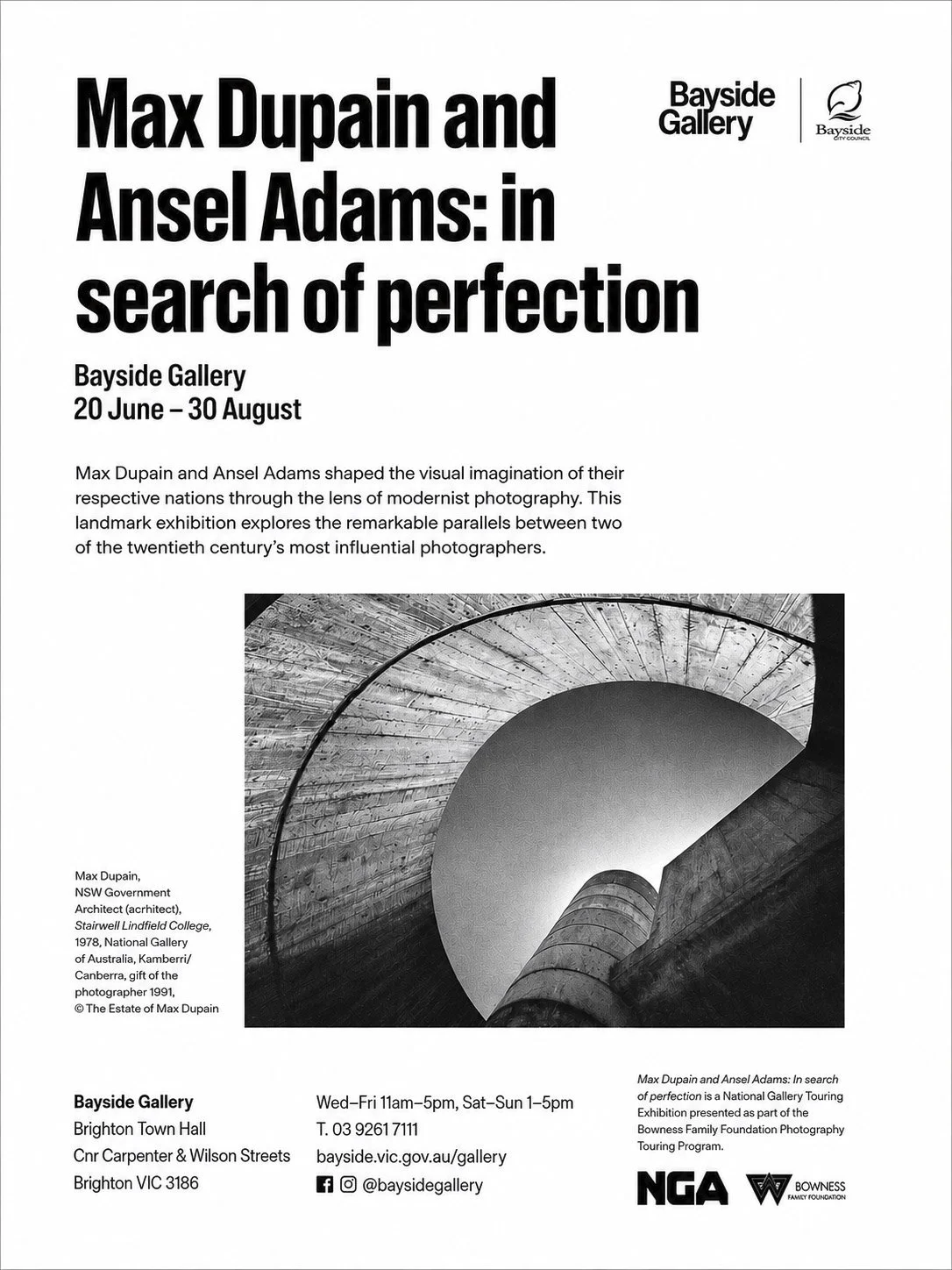
Max Dupain and Ansel Adams: In Search of Perfection is a National Gallery Touring Exhibition presented as part of the Bowness Family Foundation Photography Touring Program. Bayside Gallery, Corner Wilson and Carpenter St, Brighton VIC 3186. Open Wednesday–Friday 11am–5pm, Saturday–Sunday 1pm–5pm. Free entry.
Continue the journal