Autumn in the Macedon Ranges and Daylesford: 10 Best Photography Locations in Victoria
Photography locations · Victoria
The first thing you notice in the Macedon Ranges during autumn isn't the colour. It's the atmosphere.
Fog moves between towering trees before the sun reaches the canopy. Cold mountain air carries the scent of rain and wet earth through forests that feel, in the half-light of early morning, as though they belong somewhere else entirely. The Macedon Ranges during autumn has a quality that's unusual in Australian landscape photography — a moodiness that owes as much to the mountain climate as to the deciduous trees that generations of garden-makers planted across its slopes.
Extend the circuit into neighbouring Daylesford and Hepburn Shire and the mood deepens further — a region of volcanic lakes, heritage townships, and quiet country roads lined with oaks and elms that deliver some of Victoria's most rewarding autumn colour without the crowds of the mountain locations.
The colour comes gradually. One morning the avenue is still green. A week later the pin oaks are burning amber. By the final week of April, fallen leaves cover the roads and mist settles into the valleys before sunrise like something that was always meant to be there.
These are the ten locations I return to every season — chosen not only for colour, but for the kind of light and atmosphere that makes a photograph worth making.
The autumn circuit
Ten locations across Macedon, Daylesford and Kyneton.
When to visit:Peak colour runs from mid-April to early May, though conditions vary each year. Cold summers push the peak later; warm autumns can see colour arrive in late March. Overcast days and rain deepen colour dramatically — don't discount grey mornings. Dawn and the hour before sunset are consistently the strongest times to shoot across all locations.
Zoom and explore here, or open Dani’s complete route in Google Maps.
Open the full route ↗01 · Photography location
Honour Avenue, Mount Macedon
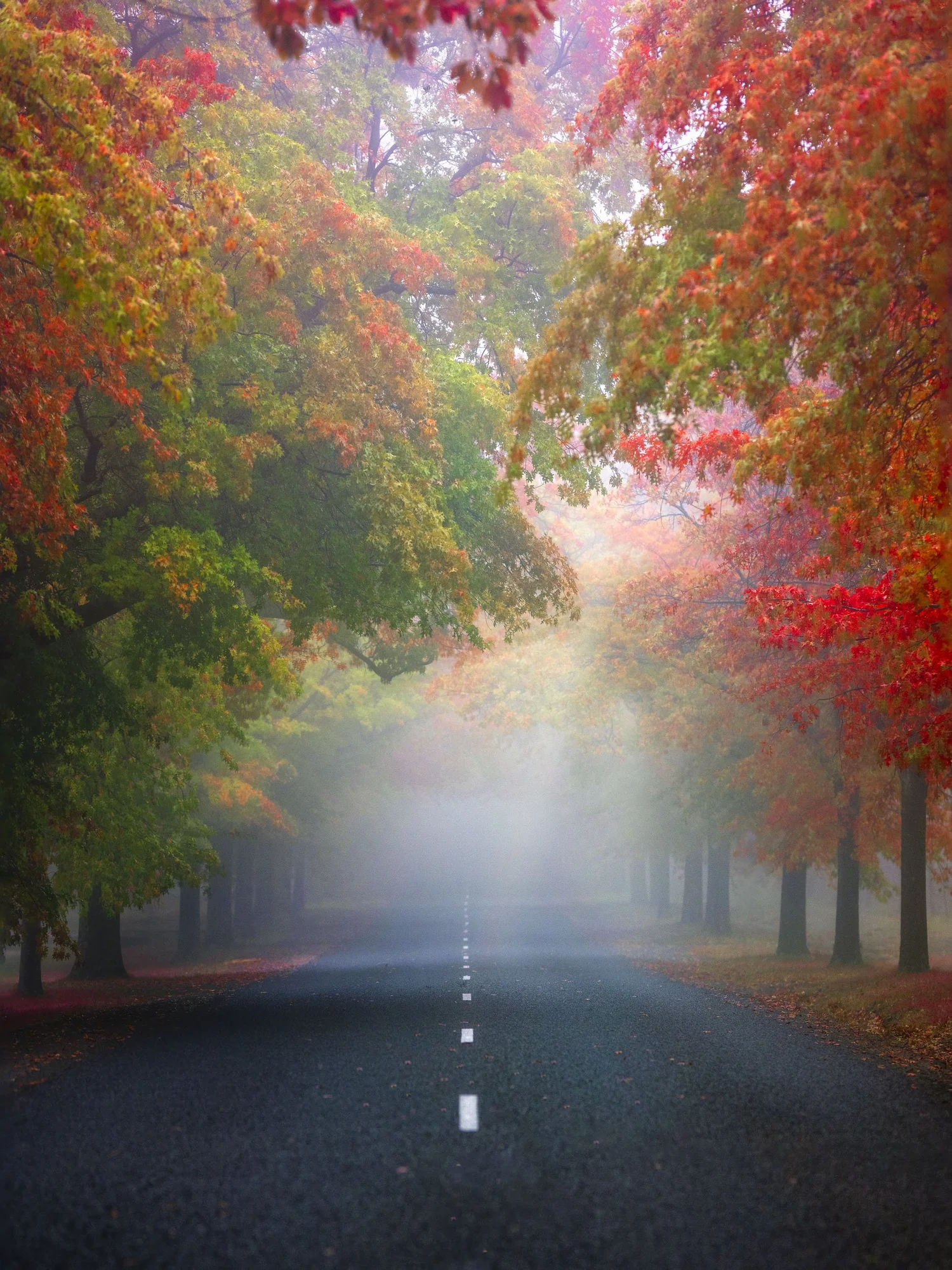
The most iconic autumn location in the Macedon Ranges, and for good reason. One hundred and fifty-four pin oak trees line the avenue in arching rows of crimson, burnt orange, amber, and gold — creating a tunnel of colour that, during the right morning fog, becomes one of the most visually arresting scenes in Victoria.
The symmetrical composition looking down the avenue is the obvious shot, and it earns its reputation. But the quieter images often carry more weight — reflections in puddles after overnight rain, isolated leaves against wet asphalt, or headlights dissolving softly through fog before sunrise.
The road is closed to traffic during peak season, which removes the distraction of cars but increases pedestrian crowds significantly. Arrive before dawn to work the space without interruption. A wide-angle lens will capture the full sweep of the avenue; a longer focal length compresses the tree tunnel into something even more dramatic.

02 · Photography location
Forest Glade Gardens
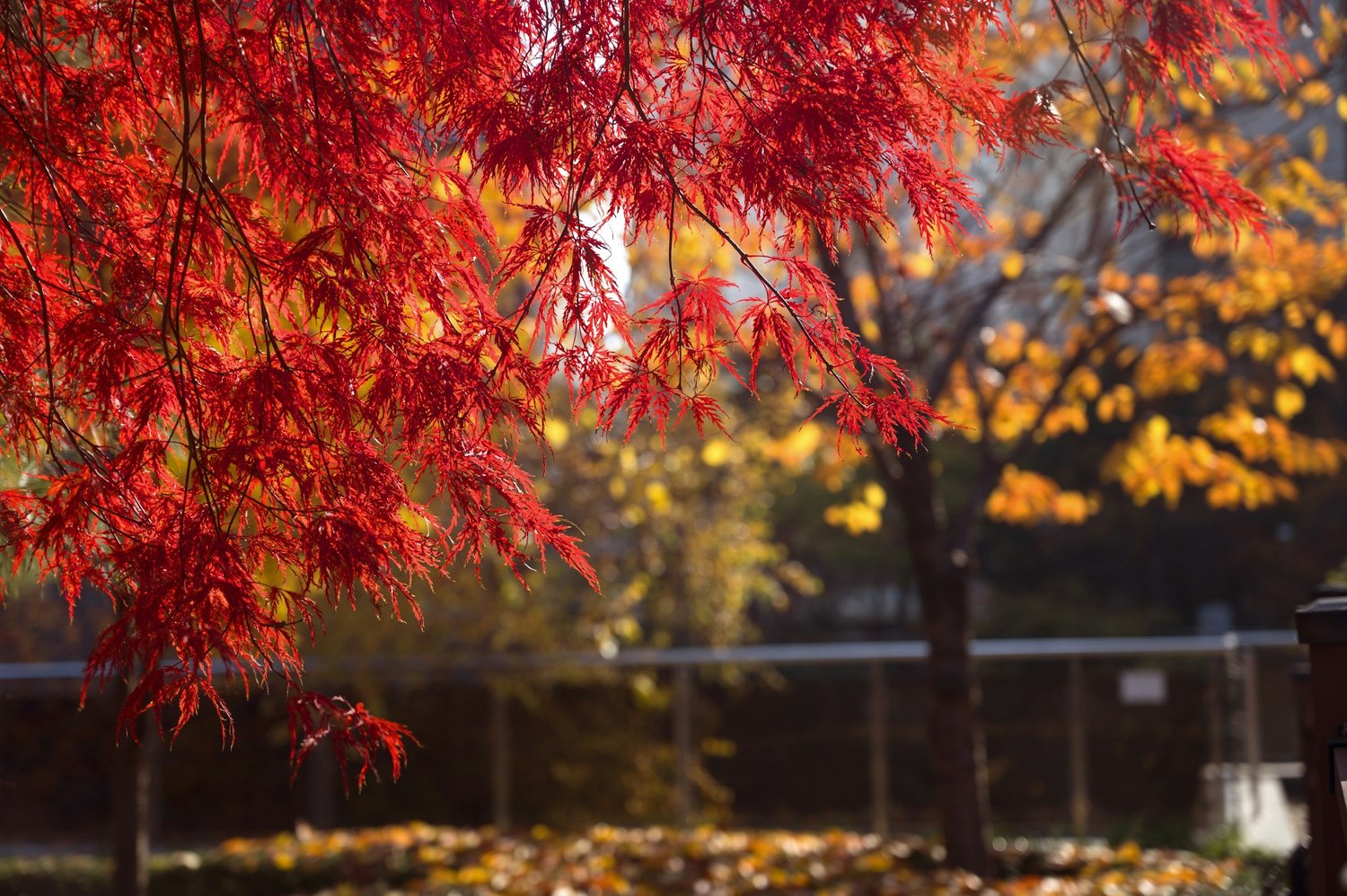
Where Honour Avenue rewards the grand composition, Forest Glade rewards patience and observation. This six-hectare historic garden on Mount Macedon Road blends English, Italian, Asian and woodland planting styles, and during autumn it becomes a study in layered colour — Japanese maples in fiery red and deep orange alongside rare rhododendrons, reflective ponds scattered with fallen leaves, and moss-covered pathways winding beneath towering deciduous trees.
The strongest work here happens when you stop looking for a composition and start looking at the light. After rain, colours deepen under overcast skies and mountain fog settles softly through the property in a way that makes even an unremarkable corner of the garden feel significant. Bring a macro lens alongside your wide-angle — the detail in a single maple leaf against dark wet stone can be as rewarding as the broader landscape.
03 · Photography location
Duneira Estate
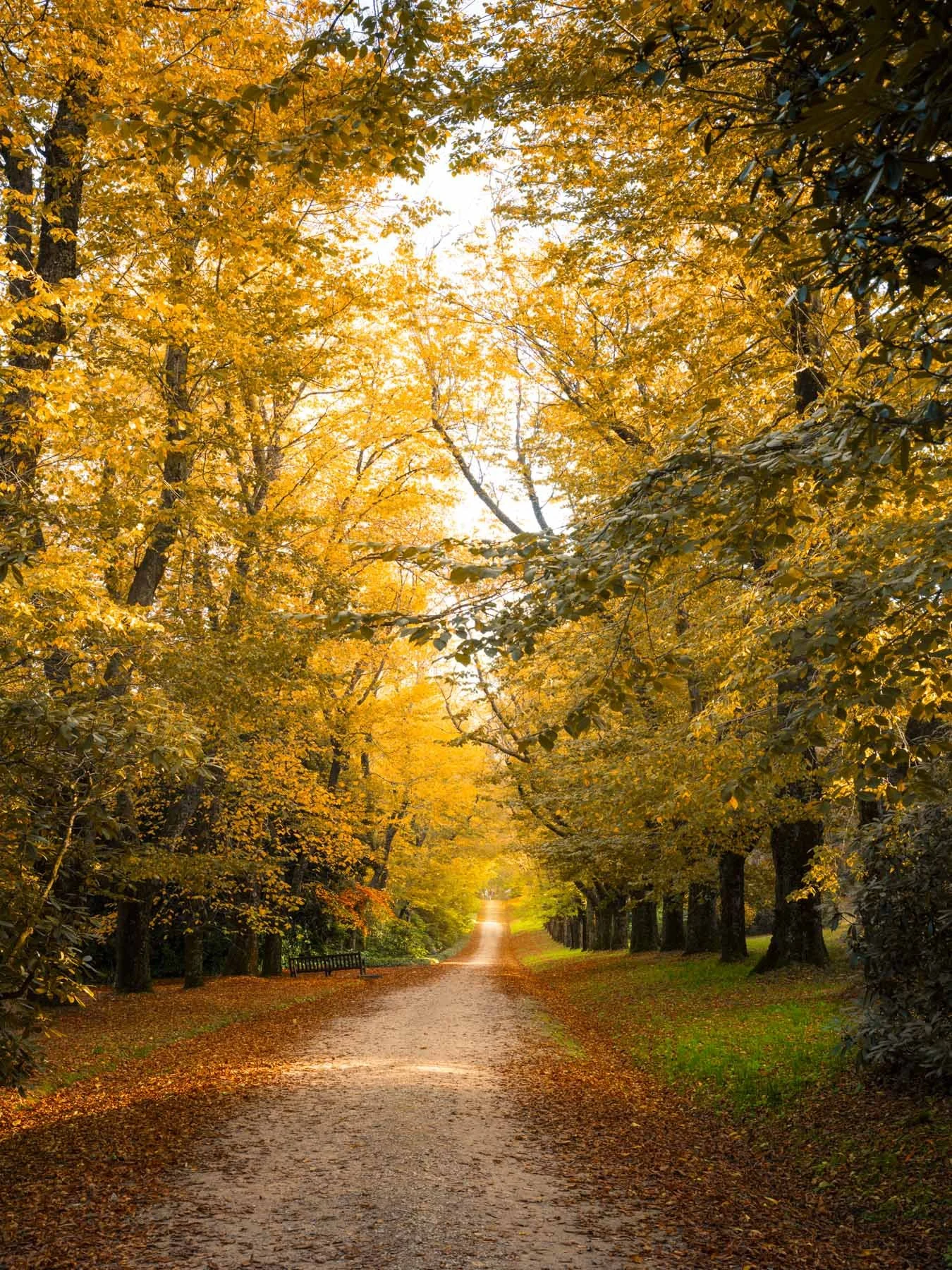
Duneira's scale is what sets it apart. A 500-metre Dutch Elm avenue anchors a 38-acre property that includes a labyrinth of hedges, orchards, and a 145-year-old weeping cherry tree that becomes extraordinary in late April. The elms create a tree tunnel with a different character to Honour Avenue — longer, more formal, the golden light through the canopy pressing in from both sides rather than arching overhead.
Visit in early afternoon when the elm avenue catches side-lighting and shadows stretch long across the gravel path. A telephoto lens compresses the tunnel effectively. The orchard and labyrinth offer intimate compositional opportunities away from the main avenue, and the weeping cherry rewards close attention in the latter half of autumn when it drops its leaves in a concentrated fall.
Entry requires advance ticket purchase ($15) on open days — check the Duneira website for confirmed dates each season.
Garden colour · Intimacy and scale
04 · Photography location
Sanatorium Lake, Macedon Regional Park
One of the more unusual locations in the Macedon Ranges, and consistently underrated. Sanatorium Lake sits within Macedon Regional Park off Lions Head Road — originally built to supply water to a tuberculosis hospital that was never constructed. The lake is enclosed on all sides by tall eucalypts, which creates a particular stillness in the early morning hours that feels almost eerie in fog.
What makes this location distinctly valuable for photographers is the combination of elements unavailable elsewhere in the region: still water for reflections, tall native trees framing the scene, and a mountain atmosphere that's slow to catch the first light due to the height and density of the surrounding canopy. On foggy mornings, the lake surface holds the mist long after it has lifted from lower elevations.
Deciduous colour here is more subtle than Honour Avenue — the interest is in the quality of light and the strangeness of the place, not a blaze of foliage. It rewards an early start and some patience.
05 · Photography location
Mount Macedon Regional Park — Camel's Hump and Memorial Cross
The regional park offers two distinct photography opportunities that are worth treating as separate visits.
The Memorial Cross — 21 metres high, considered the most significant war memorial in Victoria after the Shrine of Remembrance — provides a dramatic foreground subject against the mountain backdrop, particularly in early morning light when mist fills the valleys below. The surrounding gardens include hydrangeas that display best in early autumn before full leaf drop.
Camel's Hump, accessible via a walking trail from near the summit, offers elevated views across the ranges with rocks and native trees that make strong foreground elements. The light here changes rapidly — clear mornings can give way to dense fog within minutes at this altitude, and both conditions are worth shooting.
06 · Photography location
Macedon Uniting Church
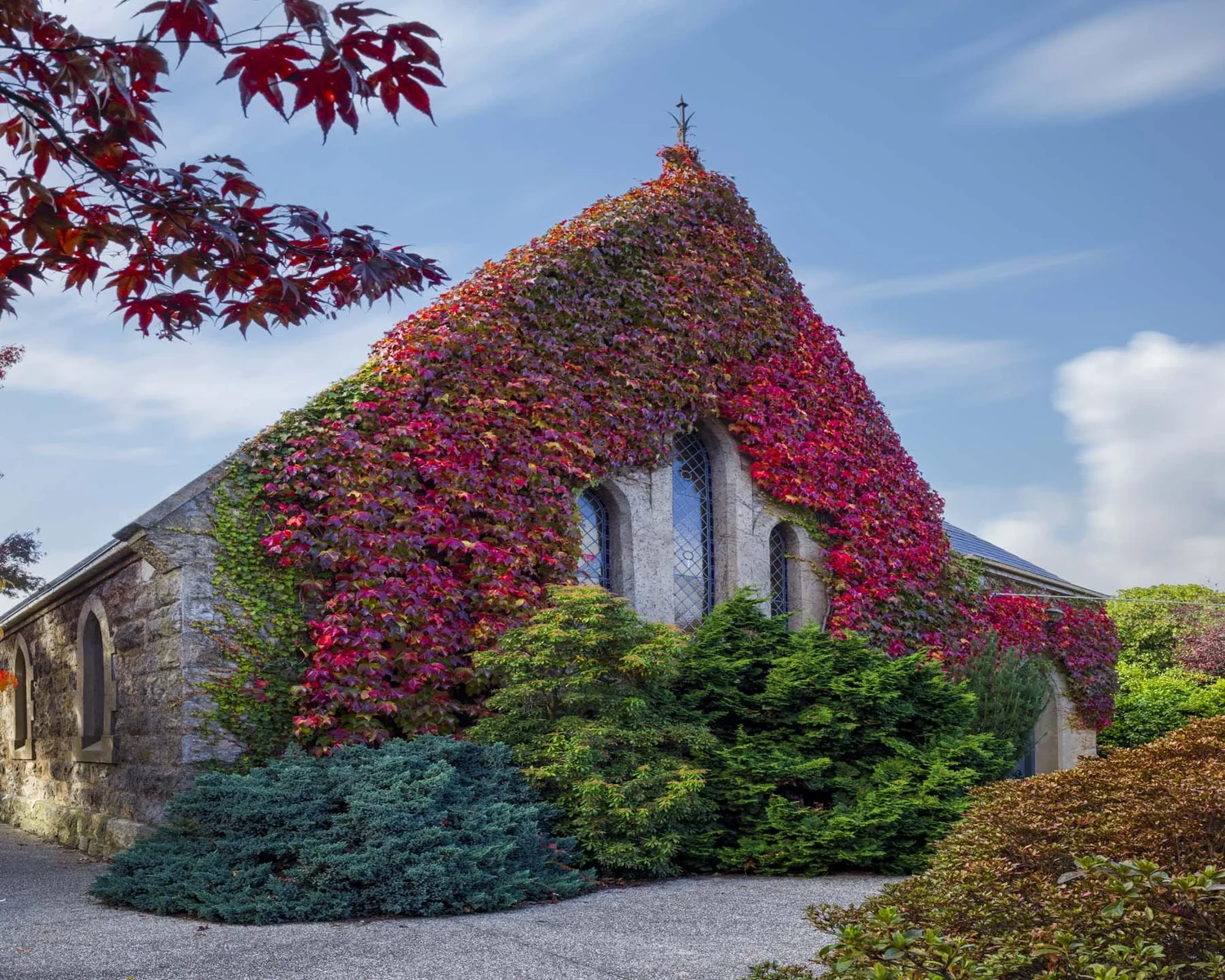
A more contained location, but one that earns its place on this list through pure visual contrast. During peak autumn, the ivy covering the church exterior transforms into deep crimson and rich red tones — white-painted architecture against fiery red and drifting mountain fog creates a scene that reads immediately and powerfully in a photograph.
After rain, the colours deepen further and the surrounding fallen leaves and wet stonework add texture to what is already a strong composition. This is a location that rewards a single strong image rather than extended exploration — find the angle that best captures the ivy against the architecture, wait for the right light, and move on.
07 · Photography location
Marorina Way
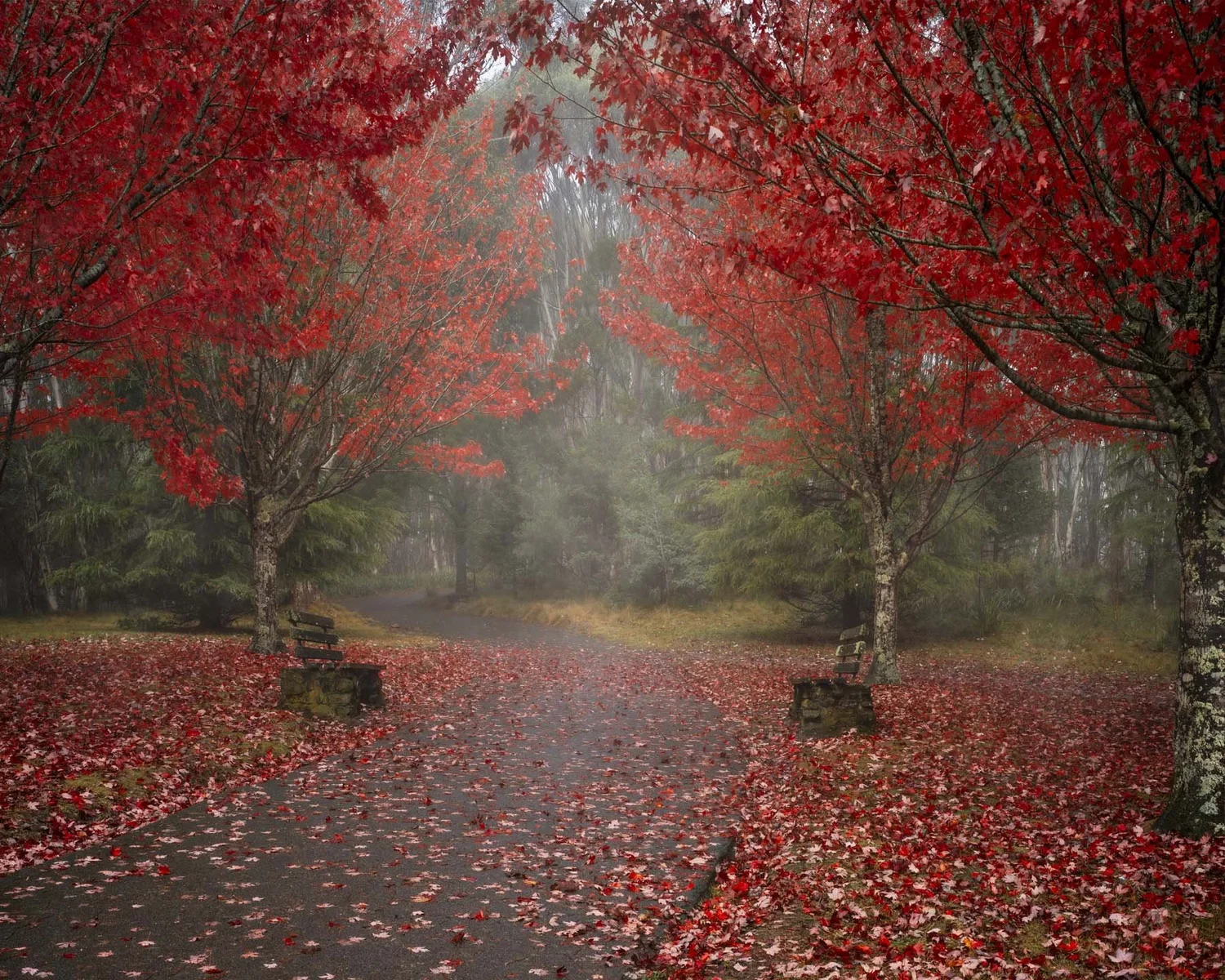
The quiet discovery of the Macedon Ranges autumn circuit. Less known than the major locations, Marorina Way produces beautiful colour throughout peak season along its winding, tree-lined road — the kind of place that feels found rather than visited.
Fog regularly settles through the road during cold mornings, and the strongest images happen when the road disappears into the mist beneath the autumn canopy. This is a location that rewards driving slowly rather than stopping — the light through the windscreen, the road receding into gold and grey, the trees closing in on both sides.
08 · Photography location
Wombat Hill Botanic Gardens, Daylesford
Set on the summit of an extinct volcano with sweeping views across Daylesford and the surrounding countryside, Wombat Hill Botanic Gardens is one of the most rewarding elevated photography locations in the region. The Pioneers' Memorial Tower at the summit provides a higher vantage point still — a bird's-eye view across a canopy of deciduous trees in full autumn colour stretching to the horizon.
The gardens are well established and mature, with elms, oaks, and other deciduous trees displaying full colour from mid-April through early May. The combination of garden plantings close up and the wider landscape beyond makes this a location that rewards both intimate and broad compositions. Because of the elevation, colour tends to persist here slightly later into the season than at lower sites.
09 · Photography location
Glenlyon — Avenue of Honour and General Store
Glenlyon is the quieter rival to Honour Avenue — a small hamlet about ten minutes from Daylesford whose own Avenue of Honour, alternating oaks and elms along the road approaching town from the Daylesford direction, creates a tunnel of colour during peak season with a fraction of the crowds.
The Glenlyon General Store, established in 1870, adds a distinctly Australian character to the location — a heritage building framed in autumn foliage that photographs well in overcast morning light. The combination of the avenue, the store, and the surrounding green paddocks and ploughed fields gives Glenlyon a layered quality that rewards a slow, exploratory visit rather than a single composition.
The road approaching town from Daylesford is the strongest autumn drive in the region after Honour Avenue — and on a weekday morning in late April, you may have it almost entirely to yourself.
10 · Photography location
Kyneton Botanic Gardens and Campaspe River Walk
Established in 1858 by Baron Ferdinand von Mueller on an undulating site sloping down to the Campaspe River, the Kyneton Botanic Gardens is one of the most historically significant and least visited autumn photography locations in the region. The collection of mature specimen trees — rare oaks, elms, cedars, giant sequoias, and a formal oak circle bordered by hawthorn hedge — provides concentrated autumn colour across a relatively compact space that is easy to work methodically.
The bluestone terraces, 1902 drinking fountain, octagonal rotunda, and heritage entrance gates add architectural interest that grounds the botanical colour in something more specific than mere foliage. The riverside walk along the Campaspe River is the most atmospheric section — large poplars drop their leaves along the steeply sloping bank, covering the ground and floating on the river below, creating the kind of scene that feels genuinely unrepeatable.
Popular subjects include the winding river paths, water reflections, the giant sequoias, and the bridges. Golden hour on a still morning before the wind picks up gives the best conditions for water reflections.
A note on conditions
Weather is part of the photograph.
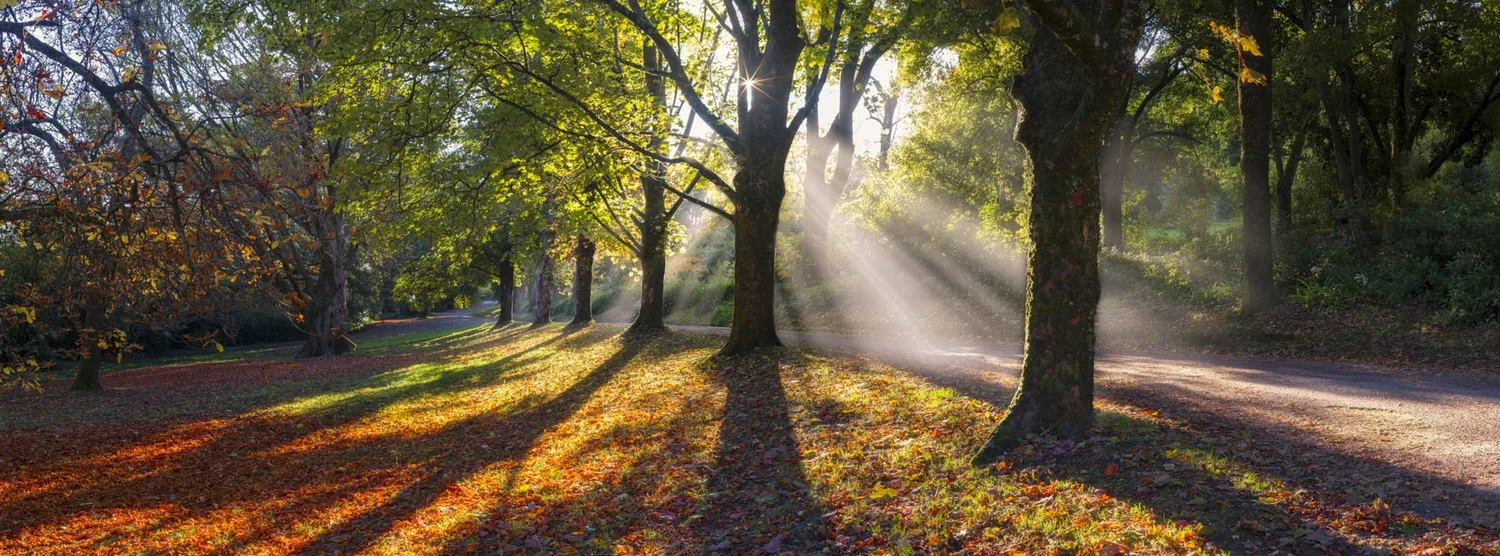
The Macedon Ranges rewards photographers who treat the weather as part of the brief rather than a problem to work around. Overcast light deepens colour more consistently than direct sunlight. Rain adds reflection and saturation. Fog transforms the familiar into the extraordinary.
Arrive before dawn, dress for cold, and allow more time than you think you'll need. The strongest images in this region rarely happen at the obvious moment — they happen in the quiet before and after, when the light is doing something unexpected and the crowds haven't arrived yet.
The season runs from mid-April to early May. It moves quickly. Go more than once.
Photograph the season
Go beyond the colour.
Dani Watson leads autumn photography workshops through the Macedon Ranges each season. For dates and availability, visit daniellewatson.com.au/workshops. Fine art prints of the Macedon Ranges are available in limited editions at daniellewatson.com.au/store.